Key Takeaways
- 1Not all non-wetting aluminium castables are built the same way. Some are based on tabular alumina and set with a low-cement binder, others are based on bauxite and set through a different (hydraulic) process, and the choice isn't just brand preference.
- 2The bauxite-based grade in our range is rated to a higher temperature, 1400°C, than our standard self-flow and high-strength grades at 1300°C, which matters if a specific zone in your furnace genuinely runs hotter than the general lining area.
- 3A higher temperature rating doesn't automatically make it the right choice everywhere. A zone chosen mainly for corundum and penetration resistance in ordinary melting or holding furnace service may not need that extra margin at all.
- 4This grade holds its strength unusually well across a wide range, testing at 100 N/mm² all the way from 110°C to 1000°C before easing to 85 and then 80 N/mm² at 1300°C and 1400°C, real tested data, not a generic spec sheet.
- 5Getting this choice right upfront avoids two expensive mistakes: paying for temperature margin a zone doesn't need, or under-specifying a genuinely hot zone and watching it fail early.
- 6"Non-wetting" isn't marketing language, it describes a real, measurable property (the wetting angle between molten aluminium and the refractory surface) that determines whether capillary action pulls metal into the lining or pushes it back out.
What's the Real Difference Between Bauxite-Based and Tabular-Alumina Non-Wetting Castables?
The difference is raw material base and bond type, not what problem the castable solves. Our standard self-flow and high-strength aluminium contact castable grades are low-cement castables built on a tabular-alumina-type aggregate, rated to 1300°C. CUMI's Tri-Mor Alcast Extra HS is a bauxite-based castable that sets through a hydraulic bond rather than a low-cement one, and it's rated to 1400°C. All three grades are still non-wetting castables engineered to resist the same failure mechanism, molten aluminium penetrating the pore structure and growing corundum, they just differ in raw material, bonding chemistry, and the resulting temperature and strength profile.
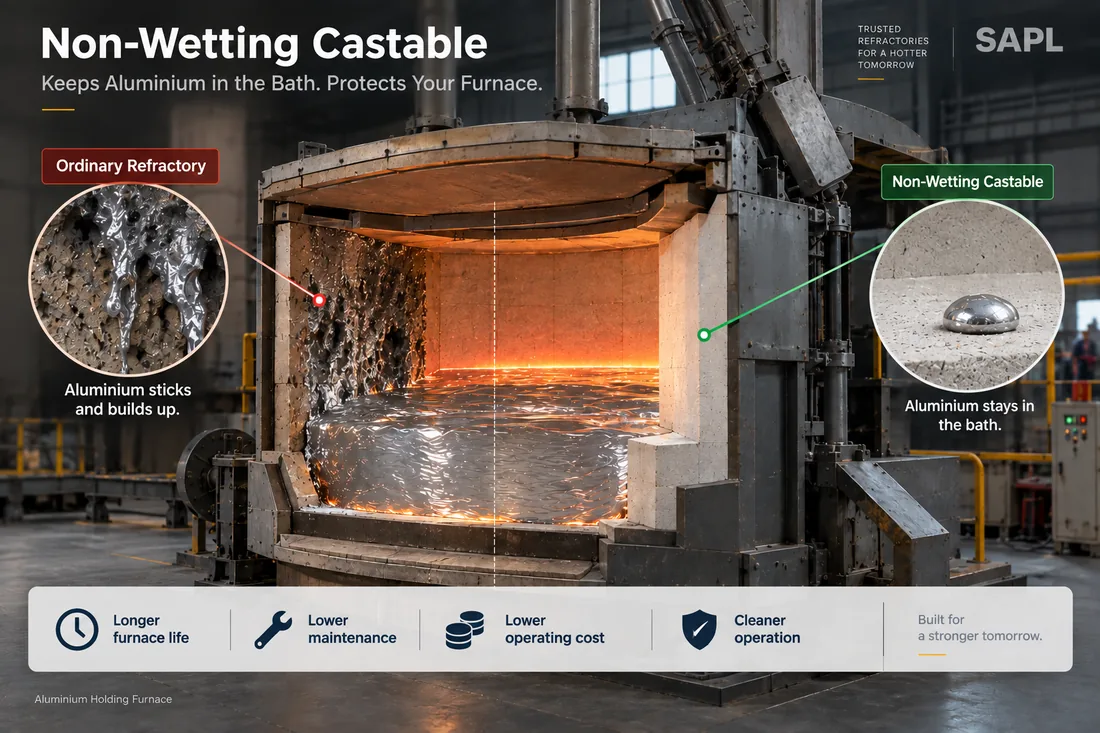
Quick answer: Reach for the bauxite-based grade (CUMI Tri-Mor Alcast Extra HS, 77% Al₂O₃, 1400°C max service) specifically when a zone's actual operating temperature exceeds the 1300°C rating of our standard self-flow and high-strength grades. For ordinary melting and holding furnace contact, corundum resistance and alloy chemistry, not raw temperature, are what actually govern lining life, and the standard grades already handle that duty.
How Does "Non-Wetting" Actually Work?
Every refractory has pores, and molten metal reaching those pores either gets pulled in or pushed back, depending on one property: the wetting angle between the metal and the refractory surface. Below 90°, the metal wets the refractory and capillary action actively draws it into the pore network, the smaller the pore and the lower the angle, the stronger that pull. Above 90°, the same capillary forces work in reverse: the meniscus curves the other way and resists penetration instead of driving it. That's what "non-wetting" means in practice, not that molten aluminium can never touch the lining, but that the surface chemistry is engineered to push the wetting angle for aluminium above that 90° threshold, so penetration has to fight the physics instead of being pulled along by it.
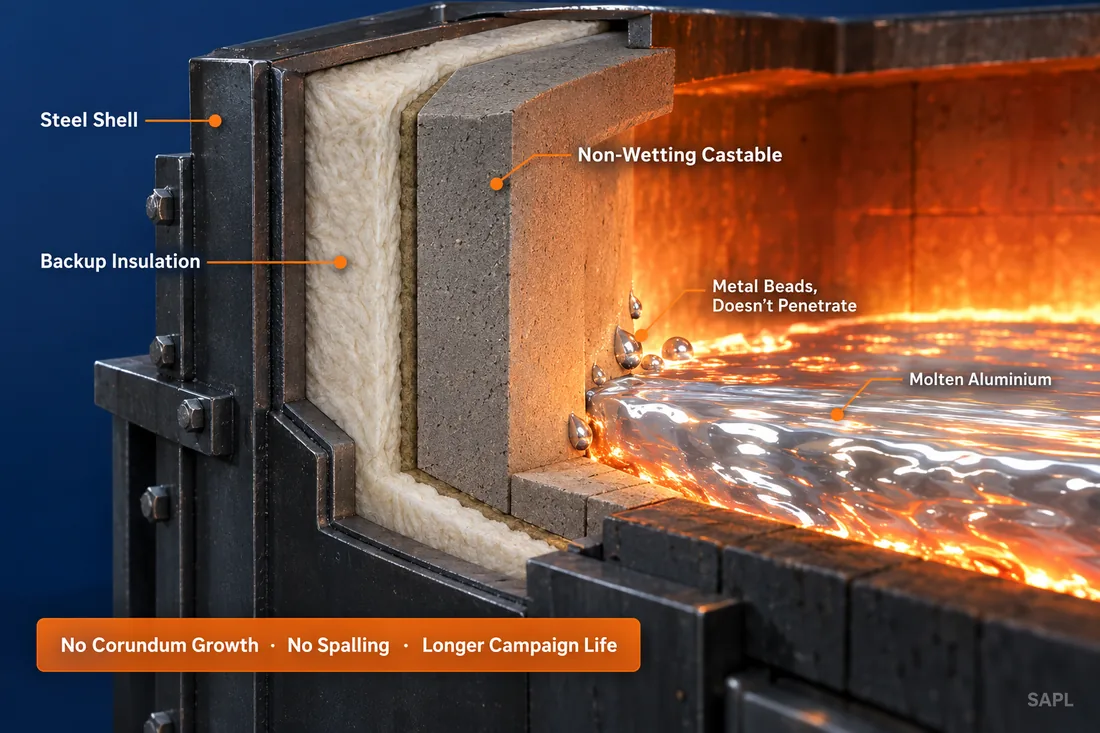
This is also why corundum growth concentrates right at the metal-refractory interface rather than throughout the lining: it's the boundary layer where any penetration that does occur first meets oxygen and starts converting to Al₂O₃, and non-wetting chemistry is specifically what limits how much aluminium ever reaches that boundary in the first place.
One honest limitation worth knowing: non-wetting additives are not a permanent, one-time fix. Published research on aluminium-refractory interaction notes that anti-wetting additives can diminish in effectiveness over an extended campaign, which is one more reason grade selection, alloy-appropriate chemistry, and routine furnace cleaning (to stop residual metal and oxide buildup from ever giving penetration a foothold) all matter together, not as a single silver-bullet material choice. For a deeper technical treatment of this mechanism, see Andrey Yurkov's Refractories for Aluminum: Electrolysis and the Cast House (2nd ed., Springer, 2017), the standard reference text on aluminium cast house refractory chemistry.
When Does the Higher-Temperature Bauxite-Based Grade Actually Matter?
Most aluminium melting and holding furnace hearth, wall and launder service sits comfortably within a 1300°C rating. The bauxite-based grade earns its place specifically where a location's real operating temperature runs higher than that, not as a general "better" upgrade applied everywhere. Specifying the higher-temperature grade in a zone that doesn't need it adds cost without adding protection against the mechanism that actually fails aluminium contact linings, corundum growth and penetration, both of which the standard grades already resist. The reverse mistake, using a 1300°C-rated grade in a zone that genuinely runs hotter, is the one that costs more: it leads to early softening and shortened campaign life. Match the grade to the measured or design temperature at that specific location, not to the furnace's overall duty description.
Real Specifications: CUMI Tri-Mor Alcast Extra HS
| Property | Value |
|---|---|
| Raw material base | Bauxite |
| Bond type | Hydraulic |
| Al₂O₃ | 77% |
| SiO₂ | 12% |
| CaO | 1.4% |
| Fe₂O₃ | 1.1% |
| Bulk density (dried 110°C) | 2900 kg/m³ |
| Refractoriness (Seger cone) | 1650°C |
| Max service temperature | 1400°C |
| Thermal conductivity (mean 600°C) | 2.3 W/mK |
| Water addition | 5.0-5.8% by weight |
| Test temperature | Cold crushing strength | Permanent linear change |
|---|---|---|
| 110°C | 100 N/mm² | nil |
| 800°C | 100 N/mm² | -0.2% |
| 1000°C | 100 N/mm² | -0.3% |
| 1300°C | 85 N/mm² | -0.7% |
| 1400°C | 80 N/mm² | ±1.5% |
Notice the strength holds flat at 100 N/mm² from dried condition all the way through 1000°C, only easing at 1300°C and 1400°C. For a lining that sees thermal cycling, that's a genuinely useful property, strength isn't the weak point until you're deep into the top of its rated range.
Comparing All Three Grades in SAPL's Aluminium Contact Castable Range
| Grade | Al₂O₃ | Max temp | Best fit |
|---|---|---|---|
| Self-Flow Non-Wetting LCC | 77.2% | 1300°C | Launders, holding furnace, general contact |
| High-Strength Al-Mg Resistant | 79.5% | 1300°C | Melting furnace, Al-Mg alloys, high-impact zones |
| Tri-Mor Alcast Extra HS (CUMI) | 77% | 1400°C | Zones with confirmed operating temperature above 1300°C |
SAPL Supply for Bauxite-Based Aluminium Furnace Castables
Why this matters: a lining bought on "highest temperature rating available" by default, rather than matched to the zone's actual operating temperature, either overspends where it isn't needed or still fails elsewhere if the wrong zone was assumed to be the hot one.
Shanker Agencies supplies CUMI's Thermal Ceramics (Tri-Mor) range, including Alcast Extra HS, alongside our self-flow and high-strength Al-Mg resistant grades. For the wider zone-by-zone picture of melting furnace, holding furnace and launder linings, see our aluminium cast house refractories guide. Tell us your furnace capacity, alloy chemistry, and the actual operating temperature at the zone you're lining, and our engineering team will confirm the right grade and quantity from your drawings.
Need Expert Refractory Advice?
45+ years of expertise · Authorized CUMI, Crown Ceramics & Divine Cerawool dealer
Have questions about the topics in this article? Our refractory engineers review your specific application and recommend the right solution, no obligation.
Frequently Asked Questions
What's the actual difference between a bauxite-based and a tabular-alumina-based non-wetting castable?
The raw material base and the bond type. Our standard self-flow and high-strength grades are low-cement castables built on a tabular-alumina-type aggregate. The bauxite-based grade (CUMI's Tri-Mor Alcast Extra HS) uses bauxite as its raw material base and sets through a hydraulic bond rather than a low-cement one. The practical result is a different temperature rating and strength curve, not a difference in what problem the castable solves, all three grades are still non-wetting castables built to resist molten aluminium penetration and corundum growth.
When do I actually need the 1400°C bauxite-based grade instead of a standard 1300°C grade?
When a specific zone genuinely runs hotter than general furnace contact temperature, not as a default upgrade. Most melting and holding furnace hearth, wall and launder service sits comfortably within the 1300°C rating of our standard self-flow and high-strength grades, and corundum growth and penetration resistance, not raw temperature, is usually what actually limits lining life in those zones. The bauxite-based grade is the right call specifically where the operating temperature at that location exceeds 1300°C. If you're not sure whether your zone needs the extra margin, send us the actual operating temperature at that location and we'll confirm.
What are the real specifications of the bauxite-based grade?
77% Al₂O₃, 12% SiO₂, 1.4% CaO, 1.1% Fe₂O₃, bulk density 2900 kg/m³ dried to 110°C, refractoriness (Seger cone) 1650°C, maximum service temperature 1400°C. Cold crushing strength runs 100 N/mm² at 110°C, 100 at 800°C, 100 at 1000°C, 85 at 1300°C and 80 at 1400°C. Permanent linear change is nil at 110°C, widening to -0.2% at 800°C, -0.3% at 1000°C, -0.7% at 1300°C and ±1.5% at 1400°C. Thermal conductivity is 2.3 W/mK at 600°C mean temperature.
Why does the strength holding steady from 110°C to 1000°C matter?
It means the castable doesn't lose meaningful cold crushing strength across most of its practical operating range, 100 N/mm² is unchanged from dried condition right through 1000°C, only easing at 1300°C and 1400°C. That's a genuinely useful property for a lining that sees thermal cycling, since strength isn't the weak point until you're deep into the upper end of its rated range.
How is the bauxite-based grade installed?
By vibrocasting, with water addition of approximately 5.0-5.8% by weight (1.25-1.45 litres per 25kg bag). This is a similar installation discipline to our other low-cement grades: correct water measurement, proper vibration to avoid voids, and a controlled dry-out schedule, trapped moisture in a dense castable causes explosive spalling on first heat-up regardless of which grade you're using.
Who supplies the bauxite-based Tri-Mor grade in India?
Shanker Agencies supplies CUMI's Thermal Ceramics (Tri-Mor) range, including Alcast Extra HS, alongside our self-flow and high-strength Al-Mg resistant grades, so you get one recommendation matched to your actual zone and alloy rather than a single default grade regardless of application.
How does "non-wetting" actually stop aluminium from penetrating the lining?
It comes down to the wetting angle between molten aluminium and the refractory surface. Below 90°, capillary action actively pulls the metal into the pore network; above 90°, the same capillary forces resist penetration instead. Non-wetting additives are formulated to push aluminium's wetting angle on the refractory surface above that threshold, so penetration has to work against the physics rather than being drawn along by it. It's worth knowing this isn't a permanent, one-time fix, published research notes anti-wetting additives can lose effectiveness over an extended campaign, which is why grade selection and routine furnace cleaning both still matter alongside material choice. See Andrey Yurkov's Refractories for Aluminum: Electrolysis and the Cast House (2nd ed., Springer, 2017) for the full technical treatment.